
Insights, frameworks, and ideas from the field.
Practical articles on coach development, player development, communication, and football education — written by the FCA team from real experience in real environments.
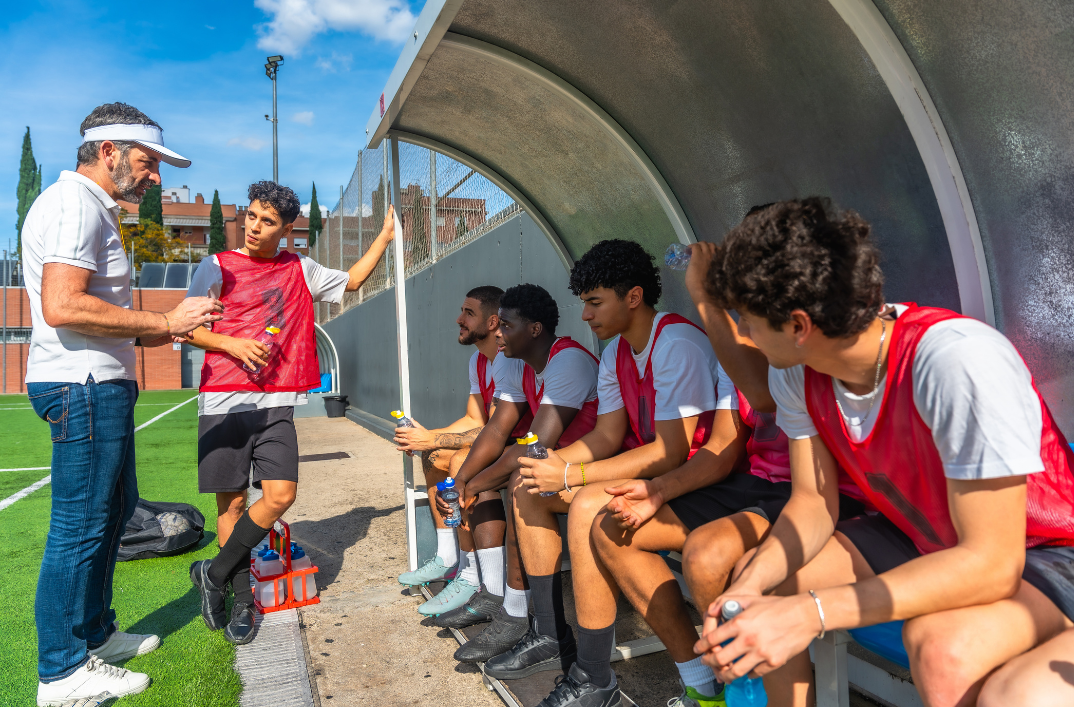
The Learning Environment: A Club’s Strongest Tool for Player Development
The Place Where Everything Is Decided
It is a normal training evening on a football pitch somewhere in Sweden.
A player tries to drive forward with the ball but loses possession immediately. The coach stops the session and demonstrates exactly how the situation should have been solved. The players nod and try again.
On another pitch a few kilometres away, a similar situation occurs. The player loses the ball — but the game continues. Teammates react, new decisions are made and the play develops further. Afterwards, the coach asks a question:
“What did you see there that made you try to go forward?”
The Place Where Everything Is Decided
It is a normal training evening on a football pitch somewhere in Sweden.
A player tries to drive forward with the ball but loses possession immediately. The coach stops the session and demonstrates exactly how the situation should have been solved. The players nod and try again.
On another pitch a few kilometres away, a similar situation occurs. The player loses the ball — but the game continues. Teammates react, new decisions are made and the play develops further. Afterwards, the coach asks a question:
“What did you see there that made you try to go forward?”
Both coaches are engaged. Both teams train the same amount. Both want to develop their players.
But the environments they create lead to completely different types of footballers.
This is one of the biggest misunderstandings in youth football: many clubs believe development happens automatically simply because training sessions are regular and exercises are well organised.
But activity is not the same as development.
Two teams can train equally often, use similar exercises and still develop completely different types of players. The difference almost always lies in the learning environment.
That is why the training pitch is the most important place in the entire club.
This is where philosophy becomes action. This is where players’ ways of thinking are shaped. And this is where the type of footballer a club truly develops is ultimately decided.
When the Training Environment Fails
When a training environment is poorly designed, the consequences are rarely visible immediately.
Sessions can still appear organised, energetic and full of activity.
But over time, certain patterns begin to emerge.
Players wait for instructions instead of taking initiative. Mistakes create insecurity rather than encouraging new attempts. Decisions become slower because players are used to the coach providing the answers.
The result is often technically capable players who lack either the courage or the habit of solving situations themselves.
That is why the training environment does not only affect performance — it also affects confidence, motivation and, in many cases, whether players remain in the sport at all.
The Biggest Misunderstanding in Session Design
When coaches plan training sessions, they often begin with exercises.
What should be trained? What should the warm-up look like? Which technique should be improved?
It is a natural way of thinking — but it risks missing the most important question:
What decisions should the players be required to make in this environment?
Modern research within sports pedagogy shows that players develop through the problems they encounter in the game and how they learn to solve them (Chow et al., 2016; Renshaw et al., 2019).
This means development is not primarily driven by isolated drills, but by how the learning environment itself is designed.
In other words:
Players do not become what coaches explain. They become what the training environment repeatedly demands from them.
The Development Environment Triangle
To understand how training environments shape development, they can be viewed through three connected dimensions — the Development Environment Triangle:
Situation – the game situations players encounter.
Decision – the choices they are required to make.
Reflection – how the coach helps them understand what happened.
When these three elements work together, an environment emerges where players develop both technical quality and game understanding.
When one of them is missing, training risks becoming mechanical.
An environment where players constantly face new situations, make decisions and reflect on them develops independent footballers.
An environment where the coach provides the answers in advance develops players who wait for instructions.
Two Training Sessions — Two Types of Players
Imagine two teams of the same age.
In the first team, play is frequently stopped for instruction. The coach corrects details and demonstrates exactly how situations should be solved. Players receive clear guidance, but the rhythm of the game is constantly interrupted and the decisions are ultimately made by the coach.
In the second team, the game continues almost constantly. Mistakes lead to new attempts rather than stoppages. The coach asks questions:
“What did you see there?”
“What options did you have?”
On paper, the exercises may appear similar.
But the learning environments develop completely different types of players.
The first trains the reproduction of instruction.
The second trains decision-making.
When SUP 2.0 Meets Reality
In Article 3, the SUP 2.0 model was introduced, where a club’s football philosophy is operationalised through three levels:
principles
behaviours
environment design
The third level — environment design — is often the most decisive.
If a club wants to develop brave players, the environment must allow mistakes.
If it wants to develop creative players, the environment must encourage exploration.
If it wants to develop responsible players, the players themselves must be allowed to make decisions.
It is not enough to simply state what you want to develop.
The environment itself must make those behaviours possible — and sometimes necessary.
The Coach as an Architect of Learning
The modern coaching role is therefore less about instructing and more about designing environments.
In practice, the coach becomes an architect of learning.
This means the coach:
creates situations where players must collaborate
designs games where decisions emerge naturally
uses questions to develop understanding
provides feedback that strengthens courage and responsibility
When coaches work in this way, players develop not only technically, but also in how they perceive and interpret the game.
Training then becomes a place where players learn how to play — not simply how to train.
The Psychological Foundation of Development
A strong learning environment is not only about game situations, but also about how players experience the environment psychologically.
Research shows that motivation strengthens when three psychological needs are fulfilled: autonomy, competence and belonging (Ryan & Deci, 2017).
Players need to feel that:
they are allowed to make their own decisions
they are developing and overcoming challenges
they are part of the team
When these factors exist, motivation becomes significantly stronger than external pressure.
Players then train not because they have to.
They train because they want to.
When Strategy Meets Everyday Reality
A club can have a clear identity, a strong player development plan and a well-functioning organisation.
But if the training environments do not reflect those principles, a gap emerges between strategy and practice.
That is why the training pitch is the place where all previous articles in this series converge.
Identity becomes visible in how players are encouraged to play. Communication structures become visible in how coaches and players speak to each other. Leadership structures become visible in how coaching staffs collaborate. Parent culture becomes visible in whether players feel safe enough to try again after mistakes.
Everything converges here.
Three Signs of a Strong Learning Environment
There are several simple indicators that a training environment is functioning well.
Players are almost always actively involved in the game. Mistakes lead to new attempts rather than stoppages. Players communicate and solve situations together.
When these signals exist, the training environment is likely aligned with the club’s developmental philosophy.
One Final Question for Every Club
Many clubs invest enormous amounts of time into strategy documents, player development plans and organisational structures.
But ultimately, everything comes down to a simpler question:
What does the training environment demand from players every single day?
Because that is exactly what they will become.
Where Future Players Are Formed
Throughout this article series, we have so far explored several structures that make development possible:
a clear identity
a communication infrastructure
an operational player development plan
a sustainable leadership structure
a conscious parent culture
All of these elements meet in the same place:
the training pitch.
This is where players experience football every week. This is where courage, creativity and responsibility are developed. And this is where the next generation of players is shaped.
In the next article, we will explore the role of feedback within the training environment — how coaches, through questions, reflection and dialogue, can strengthen players’ understanding of the game and help them develop into independent decision-makers.

The Parent Dimension: The Force That Can Build – or Break – an Entire Club
The Most Overlooked Force in Swedish Football
Imagine an ordinary weekday evening on a Swedish football pitch.
Children arrive straight from school, coaches prepare exercises, and around the pitch parents gather after rushing from work, trying to balance everyday life while chatting as their children train. A couple of parents discuss playing time from the weekend. Someone mentions another club “that maybe takes football more seriously.” A child overhears part of the conversation in passing. The coach, who is doing their best to create a safe and developmental environment, notices a subtle change in the child’s behaviour at the very next session.
These moments are often perceived as isolated incidents — simply part of everyday football culture.
But viewed from a broader systems perspective, they are clear expressions of a power factor Swedish football still does not manage strategically:
the parent dimension.
The Most Overlooked Force in Swedish Football
Imagine an ordinary weekday evening on a Swedish football pitch.
Children arrive straight from school, coaches prepare exercises, and around the pitch parents gather after rushing from work, trying to balance everyday life while chatting as their children train. A couple of parents discuss playing time from the weekend. Someone mentions another club “that maybe takes football more seriously.” A child overhears part of the conversation in passing. The coach, who is doing their best to create a safe and developmental environment, notices a subtle change in the child’s behaviour at the very next session.
These moments are often perceived as isolated incidents — simply part of everyday football culture.
But viewed from a broader systems perspective, they are clear expressions of a power factor Swedish football still does not manage strategically:
the parent dimension.
Research (Knight, 2019; Harwood & Knight, 2015) consistently shows that parents influence children’s motivation, sense of security, self-image and willingness to continue in sport more than any other actor in a child’s sporting life — including coaches.
Between the ages of 6–13, the home is a child’s primary pedagogical environment, and the emotional meaning of sport is filtered through the reactions and signals of adults.
The paradox is that clubs invest enormous amounts of time into coach education and player development, yet often spend almost no time structuring and leading the group that has the greatest influence on whether children remain in sport.
This is not a small detail.
It is a strategic blind spot — what systems theorists such as Donella Meadows describe as unused structural power: the parts of a system that quietly shape everything, yet remain invisible until the system begins to fail.
How Parents Shape Culture — Even Without Intending To
Parents are not peripheral observers; they are an active part of the club’s cultural and social ecosystem.
And their influence operates across three interconnected levels, often without anyone consciously intending it.
1. They Shape the Child’s Emotional and Educational Reality
Children are extremely sensitive to conflicting adult messages.
If a coach communicates that rotation is important for everyone’s development, but the child hears in the car afterwards that “you should be playing more than X,” an internal conflict emerges.
Not because of bad intentions — but because there is no shared foundation.
2. They Create Informal Norm Systems
Alongside the pitch, spontaneous social structures naturally emerge:
private chat groups, conversations about playing time, different interpretations of coaching decisions.
These discussions, however well-intentioned they may be, can begin to shape team expectations faster than the club’s official communication does.
3. They Shape Children’s Long-Term Self-Image
A child’s confidence is built through everyday conversations around the kitchen table, in the car and within the emotional climate created at home.
This is where football begins to feel:
enjoyable, safe and challenging
orperformance-driven, insecure and comparison-based
Together, these three levels make parents a directly decisive factor in culture, psychological safety and long-term participation.
That is why parents can never be managed reactively.
They are a systemic component — and must be treated as one.
When Structure Is Missing, Another Structure Always Emerges
In clubs where the parent role is left undefined, alternative structures will always emerge.
Not because of bad intentions, but because of human nature:
when frameworks are absent, people naturally fill the gaps themselves.
In one Swedish under-10 environment, where the coaches worked with genuine care and strong methodology, a parallel leadership structure gradually formed among three parents. Separate chat groups appeared, playing time was interpreted independently and team selections became regular discussion points.
All of this happened in good faith.
But because the club lacked a shared platform for parent involvement and dialogue, these informal norms quickly began to take cultural control.
When the club later introduced:
a unified parent guide
clearly defined communication channels
short monthly check-ins
the dynamic changed significantly.
Coaches gained working stability. Parents experienced greater clarity. The children’s sense of security improved.
The people were the same.
The structure was different.
The Modern Paradigm: Partnership, Not Control
Many clubs attempt to solve parent-related issues through rules, lectures or formal parent meetings.
But these approaches often risk creating an “us versus them” culture, where parents feel monitored rather than included.
Modern clubs operate through a completely different philosophy:
parents should not be controlled — they should be integrated.
Not by giving them more power, but by giving them:
the right type of space
clear frameworks
a legitimate role within the environment
Ultimately, this is about safety. Predictability. Reducing uncertainty through structure.
The 3N Model: Turning Parents Into a Cultural Asset
In order to lead the parent dimension effectively, clubs need a deliberate system.
This is where the 3N Model is introduced — a framework designed to create order, clarity and meaningful involvement.
1. NORMS — The Shared Value Foundation
Norms define not only behaviours, but relationships:
how adults speak about children
how dissatisfaction is handled
how playing time is understood
how the club is represented together
Clear norms create psychological safety.
2. NEARNESS — Structured and Predictable Communication
This is not about sending more messages.
It is about sending the right messages.
Clear communication pathways, consistent tone, predictable response times and defined processes for sensitive issues ensure that small problems never become large ones.
3. NECESSITY — Roles That Create Meaningful Involvement
Parents need legitimate, clearly defined roles where their engagement strengthens the culture.
Match hosts. Tournament support. Cultural support roles.
Simple but effective responsibilities that provide direction and ownership.
People who feel included rarely become oppositional forces.
The 3N Model transforms parents into cultural teammates rather than unpredictable variables.
Why the Board Must Own This Question
Parents are the club’s largest demographic group and the group that most strongly influences:
long-term retention
leadership stability
club reputation
emotional safety
organisational sustainability
They influence:
how many children continue playing
whether coaches remain in the club
how much conflict management the administration and sporting department must handle
whether the club is perceived as safe, serious and well-organised
how much engagement is mobilised around tournaments, events and volunteer work
When boards fail to take ownership of this dimension, the parent culture becomes an invisible force influencing the club from the side.
When boards instead lead the question through structure, clarity and continuity, parents become one of the club’s greatest assets.
A Short Diagnostic for Your Club
Discuss the following three questions within your board or sporting department:
Do parents clearly understand which norms exist — and why?
Is there a unified, safe and predictable communication structure?
Do parents have defined roles that create meaningful involvement?
If the answer to one question feels uncertain, there is developmental potential.
If two or more answers feel uncertain, the issue should become a systemic priority.
Conclusion: Parents Are Not a Side Note — They Are the Infrastructure Between Everyday Life and Club Values
Article 1 described the importance of identity.
Article 2 established communication as infrastructure.
Article 3 operationalised SUP 2.0.
Article 4 demonstrated leadership structures as the architecture holding everything together.
Article 5 now introduces the dimension that connects children’s everyday lives to the club’s values:
the parents — the most present and stable force in Swedish youth football.
When parents are guided through:
clear norms
structured communication
meaningful involvement
a culture emerges where:
children feel safer
coaches gain working stability
the club reduces friction and increases engagement
the club identity becomes alive in everyday reality
In the next article, the focus shifts toward the pedagogical core:
how coaches create learning environments that develop courage, creativity and responsibility in young players — aligned with SUP 2.0 and the club’s long-term football philosophy.

Organisational Leadership: The Structure That Makes Culture Sustainable
When the Club Outgrows Its Old Structure
Leadership in Swedish grassroots football is built on engagement.
That is one of our greatest strengths — but also one of our greatest vulnerabilities.
As clubs grow, more teams are added, more coaches enter the environment and expectations around both operations and quality increase, clubs eventually face a new reality:
Without a well-designed organisational structure, it does not matter how much goodwill exists.
When the structure fails, leaders become exhausted. When roles become unclear, stress increases. When responsibilities are undefined, the entire organisation slowly begins to rely on individuals rather than systems.
That is not sustainable when a club grows.
When the Club Outgrows Its Old Structure
Leadership in Swedish grassroots football is built on engagement.
That is one of our greatest strengths — but also one of our greatest vulnerabilities.
As clubs grow, more teams are added, more coaches enter the environment and expectations around both operations and quality increase, clubs eventually face a new reality:
Without a well-designed organisational structure, it does not matter how much goodwill exists.
When the structure fails, leaders become exhausted. When roles become unclear, stress increases. When responsibilities are undefined, the entire organisation slowly begins to rely on individuals rather than systems.
That is not sustainable when a club grows.
This article therefore focuses on organisational leadership:
how clubs build a stable architecture that survives both staff turnover and changing generations of players.
A Quick Reality Test
Consider the following question:
If a new coach joined your club tomorrow, would they quickly understand:
how your club trains
what is expected from their role
who is responsible for what?
If the answer feels uncertain, the club is probably more dependent on individuals than driven by systems.
This is a classic organisational problem:
when structure is absent, working methods emerge informally, and culture becomes shaped by whoever happens to be present rather than by the club’s long-term intentions.
Why Roles Begin to Drift in Clubs
What many clubs experience as “personal misunderstandings” are often actually symptoms of unclear organisational design.
Coaches take responsibility for areas they do not formally own simply to fill empty spaces. Parents ask the same question to multiple people and receive different answers. Decisions continuously move upwards through the organisation without anyone fully understanding why. Administrative staff or board members become trapped in operational issues that should have been resolved much earlier in the chain.
This is not about a lack of competence.
It is about structures failing to support people in how they should work together.
When roles and responsibilities are unclear, inconsistency quietly enters everyday reality — and suddenly both coaches and parents begin to feel that “nothing really connects.”
The Reality of Leadership in Swedish Grassroots Sport
Unlike professional organisations, leadership turnover happens quickly in Swedish football.
Parents step away when their children change teams. Studies, work and family life alter people’s ability to remain involved.
This means continuity cannot depend on the same people remaining in place.
Continuity must instead be built into the structure itself.
This aligns closely with Henriksen (2010), who demonstrates that the quality of developmental environments depends on how predictable and coherent they are — not on individuals remaining for long periods of time.
In other words:
Clubs that build culture around people risk restarting every year.
Clubs that build culture around structure can continue developing regardless of staffing changes.
The Coaching Team — The Engine of Everyday Culture
Coaching staffs are often viewed simply as working groups where tasks are divided.
But in a modern club, the coaching team is one of the central structural carriers of the club’s culture and educational philosophy.
In order to function effectively, the team must be:
Clear — roles and responsibilities should be easy to understand
Aligned — everyone within the team should use similar language, methods and priorities
Pedagogically unified — players should not receive five different interpretations of what the club stands for
One example illustrates this clearly:
A club with five highly engaged coaches within one age group delivered strong training sessions — but player behaviours varied significantly depending on who led the session. During the transition from 7v7 to 9v9, the issue became particularly visible: the players recognised the coaches, but not the club’s way of playing.
This was not a reflection of coaching quality.
It was the consequence of lacking a structured leadership platform.
The Leadership Axis — A Model for Sustainable Organisational Design
For a club to function sustainably over time, the structure must be both easy to understand and easy to carry forward.
One way of describing this architecture is through what can be called the Leadership Axis, consisting of three interconnected dimensions:
1. A Vertical Chain of Responsibility
A clear movement of responsibility:
players → coaches → coaching staff → sporting director/youth coordinator → administration → board.
When everyone understands where questions belong, friction and confusion decrease significantly.
2. Horizontal Alignment
Coaching staffs and teams within the same age group operate according to shared principles and common language.
This creates safer transitions for both players and coaches.
3. An Annual Rhythm That Creates Continuity
Kickoffs. Educational workshops. Mentorship structures. Development dialogues. Seasonal evaluations.
A rhythm that ensures important processes repeat every year — regardless of staffing changes.
The Leadership Axis connects everything established in Articles 1–3:
identity, communication structure and the SUP 2.0 model.
What This Means for the Board
The board carries ultimate responsibility for the long-term sustainability of the club.
That means organisational design is not merely an operational issue — it is a strategic one.
When structures are unclear, several consequences emerge:
increased workload
coaches feeling isolated
disagreement around expectations
more conflicts between teams, parents and administration
difficulties maintaining the club’s “red thread”
When structure becomes clear, the opposite begins to happen.
The board gains working stability and can focus on long-term development.
The organisation starts functioning because it was designed to function — not because a few individuals are carrying an unsustainable burden.
An Exercise to Evaluate Your Own Structure
Take out a blank sheet of paper.
Draw your organisation:
players
coaches
coaching staffs
sporting director/youth coordinator
administration
board
Then ask yourselves:
Does everyone understand the chain?
Are the roles clear?
Is any part missing?
Is the structure consistent throughout the entire club?
This exercise takes between two and five minutes.
But the result quickly reveals whether your club stands on stable foundations — or on person-dependent solutions.

The Player Development Plan: The Plan Every Club Has – but Few Truly Live
The Plan Every Club Has – but Few Truly Live
Almost every Swedish football club today has a player development plan.
It is carefully written, anchored in the club’s values and presented at the beginning of the season. It contains ambitions, principles and guidelines.
Yet the same question still emerges in many clubs:
“If the plan is so clear — why does reality look so different between teams?”
Players experience different expectations depending on the coach. Transitions between game formats feel like complete restarts. The same concepts are used — but interpreted differently.
The problem is rarely the quality of the document itself.
The problem is that a document alone does not change behaviours.
And it is behaviours — not formulations — that shape culture.
The Plan Every Club Has – but Few Truly Live
Almost every Swedish football club today has a player development plan.
It is carefully written, anchored in the club’s values and presented at the beginning of the season. It contains ambitions, principles and guidelines.
Yet the same question still emerges in many clubs:
“If the plan is so clear — why does reality look so different between teams?”
Players experience different expectations depending on the coach. Transitions between game formats feel like complete restarts. The same concepts are used — but interpreted differently.
The problem is rarely the quality of the document itself.
The problem is that a document alone does not change behaviours.
And it is behaviours — not formulations — that shape culture.
A Quick Test for Your Club
Ask a simple question within your sporting department:
“If two coaches in your club were asked to describe what ‘brave football’ means, would they give the same answer?”
If the answer feels uncertain, the plan is not yet operational.
It is an idea — not a system.
Organisational research shows that when guidelines remain open to interpretation, individuals naturally fill in the meaning themselves (Weick, 1995).
Within club environments, this leads each coach to gradually create their own version of the plan — often without even realising it.
This is how the club’s “red thread” slowly begins to unravel.
What Research Says About Development Environments
Within talent development research, the conclusion is clear:
it is the consistency of the environment over time that determines quality — not isolated interventions (Henriksen, 2010).
Ecological dynamics further demonstrates that learning is shaped through the design of training environments, not through isolated instruction alone (Chow et al., 2016).
This means that if a club wants to see certain behaviours emerge, the training environment itself must make those behaviours natural.
For a football club, this means:
It is not enough to describe how you want to play.
You must build structures that make it difficult to do anything else.
SUP 2.0 – Principle, Behaviour, Environment
For a player development plan to truly live, it must be built across three interconnected levels.
Together, these form what can be described as the SUP 2.0 Model.
Principles
The club’s overarching ideas about how it wants to play and develop players.
Example:
“We want to play with courage during the build-up phase.”
Behaviours
Concrete actions that players should repeatedly recognise in both training and matches.
Examples:
first touch forward
switching play
breaking lines with passes
receiving under pressure
Environment Design
Training structures that systematically reinforce these behaviours.
Example:
small-sided games where points are awarded for progression through central areas.
When these three levels are aligned, the development plan becomes a living framework.
When one of them is missing, the plan remains an ambition.
This is the defining difference between a PDF document and actual practice.
A Familiar Scenario
One club launched a new player development plan with great enthusiasm.
There was a kickoff event, presentations and educational material for coaches. The plan clearly described principles and values.
One year later, however, three coaches within one age group had changed.
The new coaches received the document — but no shared walkthrough of behaviours or training design. Soon, concepts began to be interpreted differently. Players experienced noticeable changes in training content. Parents started asking questions.
Nobody was actively resisting the plan.
The club simply lacked structures for implementation.
Henriksen et al. (2020) demonstrate that cultural change requires systems capable of surviving personnel changes.
If the plan depends on a few passionate individuals, then it is not an organisational tool.
It is an individual project.
Why This Is a Board and Sporting Director Question
It is easy to view the player development plan as merely a coaching document.
In reality, it is a governance model.
If the plan is not connected to:
coach recruitment
educational structures
mentorship and support
evaluation and feedback systems
then it will not influence the club sustainably over time.
For boards, this creates a major risk:
investments in education fail to create long-term impact
culture becomes dependent on individuals
the member experience varies dramatically between teams
An operational SUP is therefore not a pedagogical detail.
It is a question of quality assurance and long-term sustainability.
How Players Experience the Difference
For players, it becomes immediately visible when the plan is truly alive.
The transition from 5v5 to 7v7 feels logical. Key concepts reappear and retain the same meaning. Expectations evolve gradually rather than abruptly. Development is measured through behaviours — not only through results.
This is what creates stable development environments (Henriksen, 2010).
And this is what allows players to recognise the identity of their club over time.
When behavioural anchoring is missing, however, every transition between teams feels like starting over again.
A Practical Exercise for Your Club
Choose one of your club’s central principles.
Write down two concrete behaviours that represent it.
Then design a training activity that systematically reinforces those behaviours.
If this process takes longer than ten minutes, the plan is probably not yet operationalised.